Confidence by Rowland Manthorpe
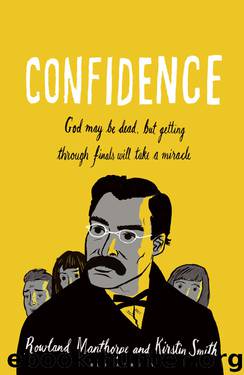
Author:Rowland Manthorpe
Language: eng
Format: epub
ISBN: 9781408833513
Publisher: Bloomsbury Publishing
Published: 2016-05-13T09:08:09+00:00
11
Beyond Good and Evil
Nietzsche challenged his readers to go ‘beyond good and evil’. He made this ‘dangerous motto’ the title of one of his books, a work he considered ‘totally terrible and repellent’, ‘a terrifying book . . . very black, like a squid’. Elsewhere he described himself as an ‘immoralist’ and spoke of the need to ‘overcome morality’. All this seems to imply that going beyond good and evil involves something ugly and depraved, an impression Nietzsche did little to dispel when he muttered darkly of the ‘crisis’ that ‘one day my name will recall’: ‘the most profound clash of consciences, a decision that was invoked against everything that had hitherto been believed’.
Although he called himself an immoralist, Nietzsche did not actually propose to discard morality altogether. ‘I do not deny,’ he wrote, ‘provided I am not a fool, that many actions that are called immoral are to be avoided and resisted; likewise, many that are called moral, should be done and encouraged.’ Instead, he sought to introduce a different kind of morality, to replace ‘Good and Evil’ with ‘Good and Bad’.
Strictly speaking, this was not an introduction but a comeback. Nietzsche’s idea of Good and Bad derived from the ancient world, where for centuries it had been the dominant model of morality. The move towards Good and Evil was brought about by Christianity, with its vision of life based on abstract extremes of salvation and damnation. It was this ‘catastrophe of the highest order’ that Nietzsche set himself to reverse.
Nietzsche called Christianity ‘slave morality’, an insult he meant quite literally. Originating among the slaves of the Roman Empire, Christianity began as a way of making victimisation bearable. To find hope in their oppression, the early Christians told themselves that powerlessness was not the punishment it seemed, because, contrary to appearances, weakness lay at the heart of goodness.
The aristocratic morality of Greece and Rome saw weakness in very straightforward terms, as a failed and contemptible version of strength. With Christianity, the slaves turned this notion on its head. They literally made a virtue of necessity by reinventing their enforced behaviours as signs of personal rectitude. Timidity became humility; self-consciousness was turned into thoughtfulness; submission to people one hates was rebranded as obedience; ‘standing at the door’ was given ‘fine names such as patience’.
At the same time, Nietzsche argued, the Christians spun the best qualities of their masters – taking charge unthinkingly, never reflecting or self-questioning, letting their inner beast run free – to make them look like vices. Strength became brutishness; healthy aggression was portrayed as bullying; acting on instinct was made to look like lack of consideration. The raw confidence of the ruling elite was redefined as unChristian arrogance.
It might sound like an ode to brute power, but with the story of the masters and the slaves Nietzsche was presenting a psychological parable. Within each of us, he said, the same conflict between strength and weakness takes place every day. To allow confidence to triumph, we have to give up our inherited assumptions about the nature of good and bad.
Download
This site does not store any files on its server. We only index and link to content provided by other sites. Please contact the content providers to delete copyright contents if any and email us, we'll remove relevant links or contents immediately.
Still Me by Jojo Moyes(11380)
On the Yard (New York Review Books Classics) by Braly Malcolm(5547)
A Year in the Merde by Stephen Clarke(5471)
Eleanor Oliphant Is Completely Fine by Gail Honeyman(5324)
The Bookshop by Penelope Fitzgerald(3900)
How Music Works by David Byrne(3327)
Surprise Me by Kinsella Sophie(3134)
Pharaoh by Wilbur Smith(3013)
Why I Write by George Orwell(2987)
Churchill by Paul Johnson(2633)
A Column of Fire by Ken Follett(2631)
The Songlines by Bruce Chatwin(2597)
The Beach by Alex Garland(2575)
Aubrey–Maturin 02 - [1803-04] - Post Captain by Patrick O'Brian(2319)
Heartless by Mary Balogh(2275)
Elizabeth by Philippa Jones(2228)
Hitler by Ian Kershaw(2219)
Life of Elizabeth I by Alison Weir(2117)
Harry Potter and the Cursed Child by J. K. Rowling & John Tiffany & Jack Thorne(2094)
